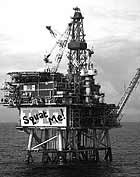
 Salman Rushdie in ‘death threat for oil’ deal.
In September 1998 Britain and Iran struck a deal at the UN to end the death threat on Salman Rushdie, author of The Satanic Verses. It was widely reported as a victory by the UK government for freedom of speech.
Yet Iranian radio reported Foreign Minister Kamal Kharrazi as saying, “We did not adopt a new position with regard to the apostate Salman Rushdie… In fact, it was the British government which decided to elevate its political relations with Iran.” [1] The British Government had relaxed its demands, by settling for a verbal rather than a written statement from Iran and by waiving the requirement that the bounty be annulled [2]. And only a fortnight after the agreement the Iranian religious organisation the 15th Khordad Foundation added $300,000 to the $2.5m price on Rushdie’s life [3].
So why did Britain cave in?
The answer lies underneath Iran, where 9% of the world's oil and 16% of its natural gas reserves are located [4]. British oil companies have been tentatively developing their relationship with Iran over the last few months. Monument has been swapping oil with Iran since July. Shell also trades in Iranian oil, and is involved in pipeline projects. Premier Oil has a stake in the offshore Balal oilfield. Aberdeen-based oil services company Abbot Group has projects in Iran, which it is looking to expand. Lasmo is also interested.
British Petroleum was founded in Iran in 1909, as the Anglo-Persian oil company, and for 70 years was a major reason for the exploitation of Iranian people by their governments [6]. The protection of Western oil interests against those of the Iranian people was at its most severe in 1953, when MI6 and the CIA orchestrated a coup in Iran to remove a government which was hostile to BP [7].
But the same company is at the centre of the story again now, in 1999. For a start, the BP Amoco merger was designed to make possible lucrative investments in these risky areas - according to one analyst: "Can you imagine the next time Shell sits down to negotiate in Tehran? They will no longer be in a league of their own. As [John Browne] said, this week's deal is all about choice, and it is in places like Iran where it will be felt" [8]. The company now has a Tehran office, for the first time in 20 years.
In June 1998 Tehran issued a tender for a $400m, 400 km pipeline to carry Caspian oil to refineries in the north of the country - the aim being eventually to extend this to the Gulf ports [9]. This is likely to be cheaper than the other two Caspian export options – north through Chechnya and Russia to the Black Sea, or west through Georgia and Turkey to the Mediterranean. Thus a good Anglo-Iranian relationship will help protect BP Amoco's existing as well as future oil supplies.
However, good business sense is not necessarily good political sense. The Salman Rushdie deal will increase tension between the moderates and the religious hardliners, between whom power in Iran is shared. And with the threat that Iran may be able to develop nuclear weapons, we have to ask whether being nuked in twenty years is a fair price for cheap petrol now.
By Greg Muttitt, with additional material from 'The Price of Oil, The Price of Life' by Keith Fisher. http://www.flyingfish.org.uk
[1] - BBC World Service, 3/10/98
[2] - see eg Times or Telegraph, 25/9/98
[3] - Afshin Valinejad, Associated Press, 10/10/98
[4] - Institute of Petroleum, Oil Data Sheet 19, 26/8/98
[6] - See 'The price of oil, the price of life'
[7] - JH Bamberg - The History of the British Petroleum Company, vol.2, p.489
[8] - FT, 13/8/98, p.27
[9] - FT 1/7/98, p.4
On 31st December 1998, BP and Amoco signed their merger deal. The new company, BP Amoco, joins Shell and Exxon in the oil super-league. Workaholic John Browne is the CEO, furthering his plans to make his mark on the oil business, having now grown out of the shadow of David Simon - the former BP Chief Executive who moved to Whitehall.
But BP has more in common with New Labour than just Lord Simon. It combines - in spin - healthy business performance with a publicly acceptable face of environmental protection. John Browne was the first of the oil heavyweights to call for action on climate change (without of course downsizing the oil business), and has been working in "partnership" with several major NGOs. BP Amoco will be the biggest producer in the North Sea, where the UK has been very keen to push the EC's plan for publicly available environmental impact assessments. And the deal will help boost BP’s position in natural gas - the fossil fuel industry’s answer to climate change. Amoco’s gas reserves are 4 times the size of BP’s [1].
The combined company will be based in London, just a few streets away from the International Petroleum Exchange, which is leading the development of a trading market in CO2 emissions permits. The merger will not only make the UK even weightier as a centre of corporate power, it will help spread the Third Way vision to the oil business as a whole.
The trend catches on…
Just three months later, two more mega-mergers were on the table. Exxon and Mobil are to combine, in the world’s biggest ever industrial merger - reuniting the two largest remnants of John D Rockefeller’s Standard Oil, which was broken up by anti-trust regulators in 1911. Back in Europe, French Total is to take over Belgium’s PetroFina.
The spate of mergers is partly brought on by the low oil price - reinforcing the need to cut costs. For example, the Exxon-Mobil deal will shed up to 14,000 jobs [2]. (Meanwhile, Exxon’s Lee Raymond, who will head the new company, earned a cool $2.4m last year [3], and is unlikely to vote himself a pay cut).
The main reason, though, is the sheer financial muscle the merged companies will have. They will be able to call the shots over regulators and governments worldwide. Exxon-Mobil will be bigger than Denmark, and 50% bigger than Saudi Arabia, and BP-Amoco will be bigger than Colombia [4].
The increased size of the companies will allow them push further into frontier areas - pristine rainforests and other delicate ecosystems, homelands of uncontacted indigenous groups, and politically unstable regions where human rights are routinely abused.
[1] - FT, 12/8/98, p.19
[2] - FT, 2/12/98, p.30
[3] - (not including share options, which generally make up the largest part of executive pay) - Hoover's Handbook of American Business 1997, vol.1, p.555
[4] - UN Statistical Yearbook, 1997, pt.3, and FT, 2/12/98, p.1
In early November 1998, Hurricane Mitch, the deadliest Atlantic storm in 200 years, swept through Honduras, Nicaragua, El Salvador and Guatemala. It took the lives of over 10,000 people, the homes of a million, and the livelihoods of over three million.
Meanwhile, in Buenos Aires (trans. "good air"), negotiators from around the world managed to ensure that there will be plenty more catastrophes to come. The fourth major climate summit (Kyoto was the third) was intended to sign the Kyoto Protocol and to agree mechanisms for its implementation. The crucial issue of whether the agreed targets (a 5.2% cut in emissions, compared to the 60-80% called for by the UN's scientists) were scientifically adequate was not discussed.
The Global Climate Coalition [see CW4] has continued to lose credibility globally (in April this year, Shell followed BP in pulling out), but at home in the all-important USA it remains extremely powerful. In the run-up to the Kyoto summit, the GCC ran a $13m advertising campaign, claiming Americans would have to pay an extra 50 cents per gallon of gasoline, and that any agreement at Kyoto would not work, because developing countries won’t cut back [1].
Influenced by these arguments, five industry-sponsored Congressmen held a press conference to persuade the Clinton administration not to sign the Kyoto Protocol [2]. The US did sign, but as rather a token gesture, since the Senate, also under the influence of the GCC, has passed a motion that the Protocol should not be ratified in the US until developing countries are also committed to reducing emissions. The question of whether developing countries should cut back was probably the biggest block in Buenos Aires.
Using another great idea from the GCC, rich countries argued that "flexible mechanisms" - allowing them to buy emissions credits from other countries rather than cutting back themselves - are needed to enable them to meet their targets. CO2 emissions are to become THE next tradeable global commodity.
At the negotiations themselves, the brutally effective advocate for fossil fuels is Don Perlman, the so-called High Priest of the Carbon Club [3]. He is known as a political genius, and can usually be found whispering to the delegates from OPEC, and the major consumer nations, so as to wreck any agreement. He works for American law firm Patton, Boggs and Blow, whose clients include Exxon, Texaco and Shell. One classic stalling tactic which came up again in Buenos Aires was the claim by OPEC nations that they should be compensated for loss of income due to global CO2 emissions reductions.
So with almost no progress on all the major issues, about 140 items have been postponed for discussion in 2000.
[1] - Ozone Action - 'Summary of Global Climate Coalition Activities, 1996-1997', March 1998
[2] - Climate Action Network - Eco #5, 11/11/98, p.3
[3] - Der Spiegel, 14/1995, pp.36-38