One of the principle features of transnational corporations is their rapid ability to relocate their operations. If one community, bio-region or country successfully resists, another gets it in the neck. Co-ordinated resistance across the planet is required. Dr Simon L. Lewis takes a look at some of the networks making this co-ordinated action a reality.
The fact that trade and capital (money) have global reach is not new. Think back to the slave trade, to the imperial colonisation of peoples, lands and cultures. All transnational. All for profit. What is new, however, is the process of dismantling national ‘restrictions’ on trade and the free movement of capital, a phenomenon which has come to be known as “economic globalisation”. Left unchecked, capitalism’s boundless drive for expansion and profit recognises no limits. Capitalists have repeatedly shown they have no qualms about exploiting people (e.g. workers in Vietnam stitching high-street brand name clothes) or the environment (e.g. exploring for new oil despite evidence and predictions of climate change by scientists) in the name of profit. Where successes have been achieved in resisting this exploitation, they have largely been through determined grassroots resistance.
Imagine some company wants to “invest in your community” by building a toxic waste dump next to where you live. You fight it. But you need large numbers of people, so you enlist other groups, non-governmental organisations (NGO’s) - whatever support you can. Maybe you manage to get a global coalition behind you. The company pulls out. You are jubilant, but somewhere is another community - perhaps in the Third World - that now has a toxic waste dump. The world is, in essence, the same as before your campaign.
This scenario describes, in caricature, one model of a “network of struggle”. As a strategy for resistance, it is flawed in three ways, two of which follow directly from the fact that “the problems” addressed in a piecemeal fashion - resisting destructive investments on a one-by-one basis.
Firstly, it is distressingly easy for modern transnational corporations (TNC’s) to flow around pockets of resistance, simply by relocating their operations.
Secondly, resistance of this type tends to be based on "single-issues" specific to the local development in question (oil terminal, nuclear power station, deforestation project etc.), and rarely gets to address the underlying cause of the problem (i.e. the predatory nature of capitalism itself). Thirdly, who decides what gets fought where?
The professional middle and upper-class staff of a large northern-based Non-Governmental Organisation (e.g. Oxfam or Greenpeace) are far better placed than a third world community group to decide that "their" issue is important, and to mobilise accordingly. Even among groups resisting power, there is still a clear power hierarchy - the privileged get to decide the fate of the underprivileged, as ever. These three flaws clearly indicate that local communities are not empowered to resist depredations by TNC’s. Even so, some struggles following this model have achieved some vital successes - the recent anti-MAI campaign was a high point (see p4). But will the millions in the South again be passive bystanders now the UK Ministers for Trade, Environment and International Development have invited NGO's to negotiate a new MAI?
Instead, let us imagine communities, individuals and families who realise their toxic waste “problem” is little different from those fighting the imposition of genetically modified crops in India, from the struggles of Mexico’s indigenous people in Chiapas, from the Ijaw fighting Shell in Nigeria, or from the 1990’s anti-roads campaigns in the UK. In fact, all over the world individuals, families, communities, ecosystems and societies are being wrecked by something variously termed “free” trade, neoliberalism, corporate rule, or globalisation. What if these people with problems rooted in this common cause began to work together?
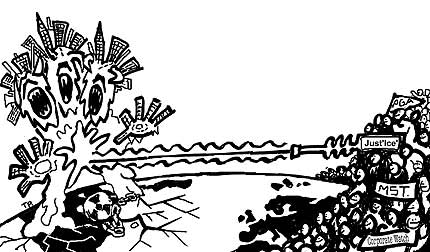
This second model of a “network of struggle” is well established, although it is not well known in the UK. These networks consist of peoples movements and groups, each engaged in empowering communities to participate in resistance activities, and characterised by mutual support, co-ordinated action, participation in grassroots-to-grassroots exchanges and structures which promote self-representation.
Examples include the “National Alliance of Peoples Movements”, a network of over 100 movements in India, and “La Via Campesina”, a global network of peasant movements including Movimento Sem Terra from Brasil (see page12).
In February this year a large network of this form coalesced. Over 400 activists from peoples movements and groups from 71 countries on all continents met in Geneva to ìlaunch a worldwide co-ordination of resistance against the global market, a new alliance of struggle and mutual support called the Peoples Global Action against “Free” Trade and the World Trade Organisation (PGA), as the first PGA bulletin stated.
From the Indigenous Women's Network of North America, to CTERA (a 600,000 strong Argentinean teachers union), to members of the FLZN (the political wing of the Zapatista movement), to London Reclaim The Streets, to the U'wa, Maori and Ogoni indigenous peoples, to the Social and Ecological Union of ex-USSR states, to the KRRS (a 10 million strong Indian farmers union from Karnataka), to anti-nuclear campaigners... all were there to form, according to PGA literature, “a global instrument for communication and co-ordination for all those fighting against the destruction of humanity and the planet by the global market, while building up local alternatives and peoples power”.
The roots of PGA reach back to the mountains of Southern Mexico. On the 1st January 1994, the day the North American Free Trade Agreement (NAFTA) came into effect, indigenous peoples from many groups calling themselves “Zapatistas” rose up. They occupied five towns, engaging in 12 days of fighting. Through the use of a battered Olivetti laptop deep in the Lacondon rainforest millions around the world have heard of, and been inspired by, the Zapatista struggle. In 1996 they invited activists from around the world to discuss common problems, tactics and solutions. A second meeting in Spain a year later led to a group of large social movements to begin to launch a more concrete campaign....
A convenors committee was born comprising ten of the largest, most innovative, social movements on the planet. An idea, an eight page bulletin, and four “hallmarks” to bring people together, flowed around the world. These “hallmarks” were:
“A very clear rejection of the institutions that multinationals and speculators have built to take power away from people, like the WTO and other trade liberalisation agreements (like APEC, the EU, NAFTA etc.”)
“A confrontational attitude, since we do not think that lobbying can have a major impact in such biased and undemocratic organisations, in which transnational capital is the only real policy-maker”.
“A call to non-violent civil disobedience and the construction of local alternatives by local people, as answers to the actions of governments and corporations.”
“An organisational philosophy based on decentralisation and autonomy.”
Enthusiasm was tapped, and within six months hundreds were gathered in Geneva. For the first time, without NGO representation or media filtering, feminists, landless peasants, ecologists, trade unionists, unemployed, indigenous peoples, students, peace campaigners all met freely. At least 20 million were involved in the groups that attended.
Between the 16th and 20th of May 1998, the first PGA-inspired globally co-ordinated actions took place to co-incide with the Birmingham meeting of the leaders of the eight most industrialised countries (G8), and the second ministerial meeting of the WTO in Geneva. As one activist-journalist from each continent travelled to Geneva, 200,000 Indian peasant farmers in Hyderabad called for the death of the WTO. Over 30 Reclaim the Streets parties in over 20 countries took place, while in Brasilia 50,000 unemployed, workers and landless peasants were on the streets. In Geneva the Director-General of the WTO had his car overturned!
Despite the links and the planning, the media have generally refused to believe that these seemingly disparate events were related, attacking the same root problems. An apparently similar disbelief has flowed among NGO’s and some activists. How can this be true? How can it work? However the really important question is this: if this process doesn't work, what will? We are only strong enough to tackle the global capitalist system and its oppression, if we tackle it together. Just ask the Vietnamese or the Sandinistas of Nicaragua about taking it on single-handedly. If it isn’t the huge number of movements involved in PGA, then who?
While there are problems (particularly the difficulty of relating one's small local campaign to diverse struggles worlds away), we need to remember that these international networks of struggle are new, and their form is unorthodox. Peoples Global Action is not an organisation, as such. It is a network and a tool. The name PGA is not registered, it has no offices, paid staff, spokespeople, funds or bank accounts. At each conference, between one and three groups from each continent (depending upon approximate population size) take on a role of “convenors”. All the convenors must change at the following conference. Thus PGA is exactly what groups do to make things happen. PGA is all of us who take on the hallmarks and act!
So what can you do? Firstly it’s about a change of mindset - thinking of your campaign in global terms, in terms of bringing about broad, lasting radical change. Secondly itís about communication. Somewhere in the world there is a town fighting a development that has never heard of D-locks, elsewhere there are indigenous peoples who have never heard the inspirational story of the Zapatistas - what’s out there waiting for you to find? Finally we need to build slowly and deliberately, without over-hasty zeal. What about the simple step of movement/community twinning? Why not make contact and cultivate links with another movement working on the same issue, or against the same company?
1998 was the first year of PGA’s existence. These are tentative beginnings. Alone we can be outflanked. At best corporations will simply flow around pockets of resistance. But, in the concluding words or the PGA manifesto, together we can “build a just world and begin to build that true prosperity which comes from human empowerment, natural bounty, diversity, dignity and freedom”.
Contact:
Western European Conveners of PGA (Reclaim the Streets, London). PO Box 9656, London N4 4JY. Tel: 0171 281 4621 Email: pga_weurope@pobox.com
Further Information on the Web:
Peoples Global Action is on: www.apg.org
Reclaim The Streets is on: www.gn.apc.org/rts
PGA-inspired international day of action centred on financial centre on June 18th is on www.gn.apc.org/june18
The Zapatistas are on: www.ezln.org
Brasil's Landless Peasants are on: www.sanet.com.br
1 Call for rebirth of moribund MAI, The Guardian, 13/11/98 p27