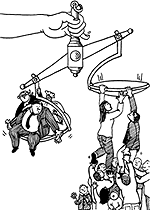
 DIY Justice, some thoughts...
 “The McLibel case is the trial of the century - it concerns the most important issues that any of us have to face, living our ordinary lives.” (Michael Mansfield QC
By the time the 'McLibel' case ended in June 1997, it was already the longest trial in English history by far. Now Dave Morris and Helen Steel are pursuing the case still further, with a recently launched appeal. In this article, Dave talks about the lessons which other activists can learn from the McLibel campaign about how we can successfully defend our movements when under attack.
In 1990, McDonalds initiated libel proceedings against Helen Steel and myself over the distribution of a London Greenpeace ‘Factsheet’. Its text high-lighted the environmental damage and social exploitation carried out by McDonalds, the food industry and multinational corporations in general. These vitally important concerns merit the widest possible unhindered public debate. Yet, whilst the giant food corporation spends $2 billion of its $30 billion annual turnover on publicity aimed at turning children and adults worldwide into passive McConsumers, it is utterly ruthless when trying to suppress any alternative points of view.
UK libel suits are massively expensive, notoriously complex and completely stacked in favour of the prosecution. Few people in the media or publishing dare to risk becoming involved in them, so they employ lawyers to vet material before it is published. This 'legalling' is in effect a form of censorship, with material that is critical of a wealthy target being particularly vulnerable (for obvious reasons), and the public is virtually unaware that it happens.
Alternatively, if the tacit threat of libel action isn’t enough to silence criticism, commencing legal proceedings usually leads quickly to a pre-trial climbdown by the defence and a grovelling and false 'apology', which the victor then can then parade around in a display of Stalinist triumphalism. This form of mass censorship benefits only the rich and powerful. Why has it never been successfully challenged or defied before? If not now, when?
We decided to fight. The case involved a vast amount of work, constant pressures and stress, and the sheer administrative nightmare of organising documentation. Yet it was an amazing and empowering experience. People rallied round to help out in all kinds of practical ways, both with the court case itself, and with the wider campaign.
We had some sporadic but vital legal advice, and witnesses were willing to come forward without being paid.
We also had to represent ourselves - Legal Aid is denied for libel cases. So we knew at the outset that we would have to get our heads round court procedure and jargon, and learn how to grill corporate executives, officials and their expert witnesses. McDonalds, by contrast, was represented pre-trial by a top QC.
Moreover, the judge denied us our right to a jury trial. But, during the course of 28 pre-trial hearings over 3 years, we quickly became practised in thinking on our feet and refusing to be intimidated. McDonalds’ QC’s confident official prediction was for a '3-4 week trial'.
In fact it lasted 314 court days and cost McDonalds an estimated 10 million pounds (against which we spent £35,000 raised from public donations!) We were able to put McWorld on trial, and they paid the bill. Representing ourselves was the most exhausting, but also the most rewarding aspect of the trial. Helen and I were determined to be seen as fighters, rather than passive 'victims'. We used to the full our right to compel McDonalds to hand over thousands of revealing internal company documents on all aspects of their business. And we were able to force their executives and experts to make a whole range of highly damaging admissions (and many ludicrous quotes too) in the witness box.
But if, inevitably, the court case itself came across as a somewhat abstract battle of ideas between two individuals and a multinational corporation, the wider campaign was a different matter. The McLibel Support Campaign was set up to galvanise widespread public interest and support, to help with legal finances and practical tasks. The Campaign organised regular supporters' mailouts and 'Days of Action'; it sought (with varying success) to make links with disgruntled employees and residents' associations opposing plans for new McDonald's stores; it gave encouragement to kids wanting to circulate anti-Ronald leaflets; it generated national and international publicity about the court case, the company and the wider issues. Crucially, some independent activists set up the 'McSpotlight' internet site which, together with an international listserver, provided people around the world with immediate access to anti-McDonalds leaflets, full daily trial transcripts, information (some of it previously censored) about the company and the court case, press coverage, and much else besides. It has been accessed over 65 million times in 3 years.
But the Campaign’s most important role was to ensure that the ‘What’s Wrong with McDonalds’ leaflet continued to receive the widest possible dissemination - its suppression, after all, was the central objective of the court case!
Thousands of volunteers signed a Pledge to distribute leaflets in defiance of the threat of similar legal action, both during and after the trial. 3 million copies have been handed out on the streets in the UK alone since the writs were served (400,000 were given out the weekend after the verdict), and there have been over a million more handed out in solidarity protests all over the world, with leaflets now available in at least 26 languages.
The campaign was run on half a shoe-string from an office in someone's bedroom. Yet it managed to turn an otherwise obscure legal proceeding into a public battle of ideas which reached millions of people worldwide, with thousands getting actively involved in spreading the message. Moreover, the courts themselves were shown to be powerless. After the verdict - in which the judge made some damning major findings against the company's core business practices - McDonald's simply capitulated by abandoning all efforts to obtain costs, damages or an injunction to stop the leafleting. This was a real DIY victory with far-reaching implications. We had felt throughout that what really counted was firstly to ensure that the often obscure battle in the courtroom would become a public issue fought in the court of public opinion; and secondly to demonstrate the power of activists who refuse to be silenced, and to make an oppressive law unworkable by co-ordinated mass defiance.
Despite being up against one of the most successful propaganda organisations in the world, the campaign was able to throw them so much on the defensive that their usual sophisticated PR machine was reduced to an embarrassed silence.
If others are inspired to similar defiance in future, could this signal the beginning of the end of such court actions?
On some aspects of the case, the judge found obscure semantic arguments and legal technicalities to enable him to rule in McDonalds favour. But we have lodged a comprehensive Appeal, in which European law will be invoked to argue against the unfair and oppressive fundamentals of UK libel laws; the hearing starts on January 12. This could be an unparalleled opportunity to stimulate further debate, and to challenge the unacceptable mass use of libel as censorship.
In what ways can courts be transformed into arenas around which public debate and struggles can be stimulated and mobilised?
Are 'natural justice' and 'civil society' much stronger than people realise? And how can supposedly powerful Legal, State and Corporate institutions be rendered powerless?
How can grass-roots movements, backed by public support, realise their potential to really take on, undermine and inspire the abolition of those institutions which currently control and dominate our lives, our society and our planet? What kind of long term, working class and community-based activity will be able to achieve this?
There are many other campaigns and movements - both in this country and elsewhere - which have involved defying legal suppression. These include the mass public non-payment of the Poll Tax; the direct action protest movements on peace, environmental and animal rights issues; free speech campaigns; struggles for the basic rights to organise and demonstrate; defiance of restrictions on the right to party or to use cannabis; occupations of unused empty homes and buildings; and of course the continuous struggles of workers and the labour movement up against employers and increasingly the courts. By drawing on this wealth of experience, we can all gain the perspective and strength to fight and win current battles and ultimately, the long war for a better world.