|
|
Campaign News
Free Papua Movement says ‘leave us alone’
Tribal people in West Papua are battling against the attempts of aggressive multinationals – encouraged by the occupying Indonesian army – to exploit gold, copper and other resources on their land.
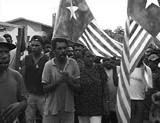 The OPM, Organisasi Papua Merdeka (Free Papua Movement), is a movement of the people in West Papua – formally established in 1962 – fighting with bows and arrows against modern weapons of the Indonesian army. Theirs is a struggle against capitalists who have been exploiting natural resources and killing tribal since the 1500s. It is not a struggle to replace one form of capitalism with another, but is a struggle for people to be able to live how they have lived for centuries and generations. The OPM, Organisasi Papua Merdeka (Free Papua Movement), is a movement of the people in West Papua – formally established in 1962 – fighting with bows and arrows against modern weapons of the Indonesian army. Theirs is a struggle against capitalists who have been exploiting natural resources and killing tribal since the 1500s. It is not a struggle to replace one form of capitalism with another, but is a struggle for people to be able to live how they have lived for centuries and generations.
For the people of West Papua, the forest is home. Respect for nature is a basic characteristic of tribal life. However, since Freeport-McMoRan and Rio Tinto came in, mountains have become valleys and people have lost their lives. These corporations have been supporting abuses of human rights and of the rights of tribal people in West Papua. Freedom that existed for generations has disappeared. The largest project planned for West Papua is a huge hydro-electric dam on the Mamberamo river, accompanied by a vast industrial complex, possibly to include processing plants for Freeport’s copper and gold, new port facilities and agro-industrial development. The plans involve ‘relocation’ of around 6000 people, many from tribes which have so far escaped much contact with the outside world. Any jobs provided by the development will go to ‘transmigrants’ from Java and Bali.
Fortunately, the bulk of these plans appear to have been put on the back burner while the new government occupies itself with more pressing problems. Little work appears to have been done on the project since 1998. At this point, lists of interested possible investors included Tarmac, German companies Siemens and Hochtief, and representatives from the British, French and German embassies.
However, the Mamberamo region is being devastated in a more casual fashion since the completion in 1998 of a road from provincial capital Jayapura (Port Numbay) on the north coast to Wamena in the central highlands. Illegal loggers and spontaneous transmigrant farmers now have access to previously unreachable areas and are destroying the forest at an alarming rate.
A door into Indonesian politics for the OPM was opened during former president Habibie’s term of office. Late in 1998, the Indonesian Armed Forces invited the OPM to a ceasefire. In February 1999, Habibie met tribal leaders from West Papua: this was seen as a step forward, in that Indonesia finally recognised the existence of the OPM.
In 1999 the West Papuan people formed a political forum called FORERI (Forum for Reconciliation of People in Irian Jaya / West Papua). The FORERI initiated a National Dialogue between West Papuan tribal leaders and President Habibie. To progress the dialogue, tribal leaders established West Papua Posts throughout the island: a First National Congress of West Papua peoples is due to take place in April 2000.
The Congress is to be followed by an International Dialogue to re-examine the Act of Free Choice, conducted in 1969, and much criticised as an underhand process of delivering power over West Papua to Indonesia. The Dialogue will involve the Netherlands government, the US, Indonesia and the UN, with a neutral country as the mediator. These three nations and the UN are regarded as directly responsible for the sufferings in West Papua. The Dutch handed over its Dutch New Guinea to Indonesia in 1970, and the US acted as the mediator on this. The UN approved this illegal invasion.
Tribal leaders, who had been regarded as the illiterate leaders of an uneducated stone-age people, are now playing important roles in modern politics. With the support of Western governments, modern guns and jet fighters have been used to destroy villages and kill people, animals and plants. It seems to the tribal peoples that ‘modern’ or ‘western democracy’ and the exploitation of natural resources go hand in hand. They urge this ‘civilisation’ to understand that they are humans too and that they have a culture and ways of governing themselves. What they demand is autonomy and tribal democracy, not Western government.
UK based companies operating in West Papua: Rio Tinto plc, 6 St James’ Sq., London SW1Y 4DL; British Gas Group and British Gas International, 100 Thames Valley Park Drive, Reading, Berks, RG6
BG International is involved in a project to produce Liquid Natural Gas.
For details of other corporations operating in West Papua contact opmsg@eco-action.org
Contacts:
OPM Support Group in the UK www.eco-action.org/opm/ E-mail: opmsg@eco-action.org
also: http://users.ox.ac.uk/~oprc E-mail: wpapua@hotmail.com
Partizans – campaign against RioTinto 0171 700 6189 E-mail: partizans@gn.apc.org
|