|
|
Magazine Issue 10 - Spring 2000
|
||
 Babylonian Times Babylonian TimesOIL SPILLS In the US alone, there are about 14,000 reported oil spills each year. The following is a list of some of the bigger ones that have taken place worldwide since the last issue of this magazine was published. NB This info is taken from various media – more spills are likely to have taken place and gone unreported. * 4th December 1999: The Marine National Park in Vadinar, India, is hit by an oil spill of unknown size from Indian Oil Company * 6th December 1999: Butinge Oil Platform, Lithuania, spills 3 tons of crude oil into the Baltic Sea during the loading of a tanker * 12th December 1999: the oil tanker Erika, run by French company TotalFina, breaks apart off French shores, spilling about 13,000 tonnes of crude oil causing severe pollution along the coast of Brittany * 29th December 1999: Russian vessel Volgoneft 248 spews 1,290 tonnes of oil into the Black Sea near Istanbul, after being broken in two during storm * 16th January 2000: oil pipeline near Sinkat, in eastern Sudan, is blown up by rebel forces according to the government, leading to an unknown amount of oil spilling out * 18th January 2000: an oil pipeline run by the state-owned Petrobras bursts off the Brazilian coastline polluting beaches near Rio de Janeiro with 500 tonnes or more of crude * 22nd January 2000: about 140 tonnes of oil spill out off the western coast of Ireland when two fishing vessels collide * 24th January 2000: oil tanker Al-Jaziya hits a sand bank, and leaks 300 tonnes of oil into the sea off Abu Dhabi, United Arab Emirates * 29th January 2000: yet another leak in Brazilian Petrobras’ pipeline, this time only causing a minor oil spill * 31st January 2000: Cochabamba-Arica pipeline operated by Transredes (controlled by Shell and Enron) spills oil, causing damage to Lake Poopo and nearby rivers in Bolivia. The company reports that about 100 tonnes of oil were being pumped through the pipeline * 1st February 2000: Liberian oil tanker sinks off the northern coast of Cuba. According to Cuban transport ministry, only a ‘smaller’ spill had occurred * 4th February 2000: Oil tanker contracted by Texaco, containing about 1600 tonnes of heavy fuel oil, sinks in Rio Para, in the Amazon jungle. Only ‘minor’ amounts have so far leaked out * 11th February 2000: oil pipeline operated by Sunoco Inc, in Philadelphia, USA, leak 200 tonnes of crude oil * 11th February 2000: spill of 50 tons of canola oil at Burrard Inlet, one of Canada's biggest Pacific coast harbors near Vancouver, when a pipe ruptured during a transfer into a tanker at the Neptune Bulk Pic: Paul Vernon BP Amoco Shareholders Force Vote on Arctic Oil Drilling The BP Amoco shareholder group SANE BP has filed a resolution forcing BP to put its oil expansion plans to a shareholders vote. The resolution, to be voted on at BP’s Annual General Meeting on April 13, calls for it to cancel its Northstar project in the Arctic Ocean and stop lobbying to open up the Arctic National Wildlife Refuge to drilling. It calls for the freed-up cash to be reinvested in the solar energy subsidiary BP Solarex. Source: Environment News Service, 26th January 2000. Little and large For the first time in human history, the number of overweight people rivals the number of underweight people - with both totals now reaching 1.2 billion - according to a recent report by the World Watch Institute in Washington DC. In the developing world there are 150 million underweight children - almost one in three. And in Africa, the number of malnourished children is rising - both as an absolute number and as a proportion of the total population. Both the obese and the underweight suffer from the disease of malnutrition - a deficiency or excess of nutrient intake - and both share high levels of sickness and disability, as well as reduced life expectancies. Not surprisingly the problem is worst in the United States, where 55% of adults are overweight by international standards and 23% are considered obese. But it's also getting worse in the poor world - in Brazil and Colombia about 40% of the population is overweight, a level matching that of many European countries. Remember: hunger does not result from food scarcity but from poverty - 80% of the world's hungry children live in countries producing food surpluses. Source: World Watch Institute, 'Chronic Hunger and Obesity Epidemic Eroding Global Progress', 4 March 2000 Terminals (Canada) Ltd. Corn to plastic Cargill Dow Polymers have leapfrogged over other plant-based plastics companies by announcing plans to build a facility to manufacture plastic products from corn. Companies have been experimenting for years with plant-based plastics as replacements for petroleum-based plastics with their toxic byproducts, wastes and inability to break down in landfills. A new technology allows the company to ‘harvest’ the carbon that living plants remove from the air through photosynthesis. The carbon and other elements in natural sugars are then used for ‘NatureWork PLA’, which will be made into utensils, packaging or fibres. Source: Environment News Service, 11th January 2000. So you thought colonialism had ended? Think again. Figures from the United Nations Development Programme show that things have actually got worse for the world's poor since the sun set on the mighty colonial empires of the nineteenth and twentieth centuries. Wealth differential between the 'First' and 'Third' worlds: •1800s 2:1 •1965 30:1 •1997 74:1 (Source: UNDP Human Development Report 1999) Economic Forum took place in Davos this January. It drew a closed circle of participants from the corporate world, governments, media, and elite universities to forge a response from the world's elite to the crisis of corporate-led globalisation. Sounds conspiratorial? More like a circus – quotes from the meeting include: - Bill Gates, Microsoft CEO, telling the head of AOL to get his priorities right, and these were the "health and education of people," particularly in the developing world. - The US Secretary of the Treasury claiming that "the US was not an empire", with the US Secretary of State seconding this. - The Indonesian President asserting that "I'm president because I'm poor." - The World Bank President stating he would probably be contented being poor if he were a Bhutanese. - Mexican President Ernesto Zedillo claiming that Mexican industry is "much cleaner today" owing to NAFTA. - World Economic Forum President stating that "carbon emissions generated by your arrival in Davos and your accommodation here will be compensated for by the planting of the necessary number of trees in Mexico." Walden Bello, Focus on Trade No.45 Feb 2000 http://focusweb.org. Merger Mayhem – size matters In a scenario reminiscent of playground bullies vying for dominance, size has been everything as companies have been tumbling over each other to merge in the last few months. A media monster was formed by the biggest US corporate merger ever witnessed when AOL and Time Warner came together to form a massive corporation worth £220 billion in February. A couple of weeks later Time Warner merged with EMI. The ongoing saga of Vodafone’s rise throughout 1999 came to a climax in as it overcame German resistance to the takeover of Mannesmann, creating the UK’s largest company. In January the world’s biggest drug company was created after the tortuous marriage of Glaxo Wellcome and SmithKline Beecham – the issue at stake was mainly the control of marketing of drugs. Similar rewards motivated Pfizer’s takeover of Warner-Lambert in February, now the world’s second biggest. At the time of writing it seems that Royal Bank of Scotland has won the battle to buy its larger rival NatWest with a bid of £21 bn. Reebok human rights award (honest) We at Reebok International are always striving to improve people’s lives. For example: human rights. Heard of sweatshops? – it’s just our modest attempt to give the poor masses in developing countries a job – doing what we can to fulfil article 23 of the Universal Declaration of Human Rights. We are interested in anyone else who has made a significant contribution to the cause of human rights? - he or she might be the one for next year’s Reebok Human Rights Award. The purpose of the Award is to "shine a positive, international light on the awardees and to support their work in human rights". For info or an application form, see http://www.reebok.com The 30th Annual Meeting of the World US to open new markets with military means The first US - Africa Energy Ministers Conference took place in the States last December with a US representative praising political and economic reforms in many African countries, saying that such efforts would open doors for private business. Africa, the rep continued, had become an important supplier of energy to the US. This Conference was followed with a February trip by the US Secretary of Defence to Morocco, South Africa and Nigeria. This trip was to include discussion of regional security matters with government and military officials. The US has recently shown an inclination to more aggressively engage in the efforts to resolve African conflicts: while serving as president of the UN security council in January, the US devoted the whole month to discussions on African conflicts. PIPELINE, Oilwatch Europe Newsletter, Feb 2000 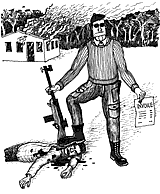 Swords for hire Swords for hireMercenaries are not something that died out roughly at the same time as feudalism. Today they, like many others, have turned to the internet, to sell ‘services’ such as ‘force design and management’ and ‘quick reaction military contractual support’.One company - MPRI, Military Professional Resources Inc - is recruiting personnel to fill up vacancies around the world. What say you, for example, about going to Nigeria, helping the Ministry of Defense and the General Staff with the ‘re-professionalization of the Nigerian Armed Forces’. Or - if maybe Latin America is more appealing – why not get a job ‘assisting the Republic of Colombia’s Ministry of Defense, General Staff and Armed Forces with their counter-drug programs and other interrelated missions’. Check out their website for yourself: www.mpri.com. Source: MPRI homesite, www.mpri.com, 15th February 2000 Gulf War Survivor After John Nicol’s jet was shot down during the Gulf War he was captured and beaten before being paraded in front of the world’s media as part of Iraqi propaganda. Today he says: "I have just been so incredibly lucky to be in the right place at the right time all my life". Bizarrely he now considers this to be the best thing that has ever happened to him: since leaving the RAF he has been in demand on the corporate-motivation circuit. Top companies pay £5000 a time for his pearls of wisdom, stirring talks about coping with crisis, and his exhortations to ‘rise to the occasion’ and go one step further. The awed insurance sales staff are suitably impressed, and motivated. Source: The Business FT Weekend Magazine 11.12.99 |