
home >> NEWSLETTERS >> Magazine 54
 Speaking at a conference in May, David Cameron said he was “thoroughly relaxed about foreign investors” in the UK and that Britain was “probably one of the most welcoming countries anywhere in the world” for them. The year before, chancellor George Osborne described the government’s decision to slash corporation tax as “an advertisement for investment in Britain”.
It’s a common refrain as governments across the world compete to lure the money of companies, banks, pension funds and other governments with ever more ‘pro-business’ policies. The investors themselves are often explicit about what they want. In Greece earlier this year, eleven aggrieved companies, including Nestle, Philip Morris and Unilever said that they would be happy to spend more in the country if only it was “more friendly to investment”. Their definition of friendship turned out to involve lowering minimum wage, especially to young or currently unemployed people.
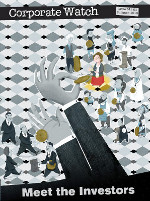
The whims and predilections of ‘the market’ are objects of obsession for a variety of financial analysts and politicians. This issue of the Corporate Watch magazine isn’t for them, but it is about investment and what these much-quoted and feared investors get out of it.
In the first article, Who are the Investors?, Dariush Sokolov gives an overview of the process of investment in a capitalist economy. He examines the biggest kinds of investors around at the moment and whose money they are spending, and questions whether “we are all investors now”.
Following this is an interview with Jan Toporowski, Professor of Economics and Finance at SOAS, University of London. He discusses what fund management entails by looking into the thinking of investment fund managers and sovereign wealth funds, ending with tentative suggestions of what kind of campaigns would best put the wind up them.
Partly in response to public resentment and anger over various corporate abuses, there has been a proliferation of ‘ethical’ or ‘socially responsible’ investments. In an in-depth analysis, Shiar Youssef and Dave Whyte investigate the growth of this phenomenon, discussing its various definitions and mechanisms, and critiquing the ability of such investments to ever be genuinely ethical.
In Power Fix? Aris Kontos looks at the Barclays energy price fixing scandal and how the bank’s ‘investment’ in the electricity market was actually a way to speculate against it.
Speaking at a conference in May, David Cameron said he was “thoroughly relaxed about foreign investors” in the UK and that Britain was “probably one of the most welcoming countries anywhere in the world” for them. The year before, chancellor George Osborne described the government’s decision to slash corporation tax as “an advertisement for investment in Britain”.
It’s a common refrain as governments across the world compete to lure the money of companies, banks, pension funds and other governments with ever more ‘pro-business’ policies. The investors themselves are often explicit about what they want. In Greece earlier this year, eleven aggrieved companies, including Nestle, Philip Morris and Unilever said that they would be happy to spend more in the country if only it was “more friendly to investment”. Their definition of friendship turned out to involve lowering minimum wage, especially to young or currently unemployed people.
The whims and predilections of ‘the market’ are objects of obsession for a variety of financial analysts and politicians. This issue of the Corporate Watch magazine isn’t for them, but it is about investment and what these much-quoted and feared investors get out of it.
In the first article, Who are the Investors?, Dariush Sokolov gives an overview of the process of investment in a capitalist economy. He examines the biggest kinds of investors around at the moment and whose money they are spending, and questions whether “we are all investors now”.
Following this is an interview with Jan Toporowski, Professor of Economics and Finance at SOAS, University of London. He discusses what fund management entails by looking into the thinking of investment fund managers and sovereign wealth funds, ending with tentative suggestions of what kind of campaigns would best put the wind up them.
Partly in response to public resentment and anger over various corporate abuses, there has been a proliferation of ‘ethical’ or ‘socially responsible’ investments. In an in-depth analysis, Shiar Youssef and Dave Whyte investigate the growth of this phenomenon, discussing its various definitions and mechanisms, and critiquing the ability of such investments to ever be genuinely ethical.
In Power Fix? Aris Kontos looks at the Barclays energy price fixing scandal and how the bank’s ‘investment’ in the electricity market was actually a way to speculate against it.
Financial liberalisation has been exported to the rest of the world through a series of international institutions. An ex-employee of the controversial European Bank of Reconstruction and Development tells Corporate Watch what life was like inside the bank and how it sees its role. Turn the page and you’ll find our centre spread, The Economic Circus, depicting the eddies and flows of money spent around the world. You get four Campaign Spotlights for the price of one this issue as people campaigning against the arms trade, G4S, animal-testing and the Israeli occupation of Palestine describe how they have targeted investors in the companies they are targeting, to try to get them to divest. Why have so few bank employees blown the whistle on their employers? Perhaps because the regulators don’t give a damn, if the case of Jonathan Sugarman in Ireland is anything to go by. In Blowing the Whistle on the Banks we publish transcripts of talks that Sugarman has given about his case since his resignation. They cover warnings to the government about what was going on in his bank before the biggest bank bailouts ever, at the same time digging into the LIBOR scandal and the cosy relationship between regulators, bankers and politicians. So is there anywhere people can put their money without contributing to the misery of others? We interview Rachel Boyd from Zaytoun, a London-based workers’ cooperative that works directly with Palestinian farmers, to market their products in the UK. This month’s company profile is about outsourcing giant Capita. Shiar Youssef digs into its ever-expanding operations in the what-used-to-be-public sector and finds profits being put above quality of service again and again. In the final article, The I Word, Richard Whittell looks at companies using claims of investment to excuse dubious behaviour, before questioning whether investment by water companies is as good value as they like to make out. Note to subscribers: The Corporate Watch magazine will no longer be a quarterly publication but will be produced irregularly. We’ve been producing lots of content on our website, plus books, profiles and reports, and we aren’t able to put out as many magazines as before. Existing subscribers will still receive four Corporate Watch publications a year but that may include reports and briefings as well as magazines. If you would rather unsubscribe and get your money back, please contact us at the addresses on the previous page. You may also notice we’ve got a new layout. As ever, please send any comments about any part of the magazine to the contact details on the previous page.
 Follow us on Twitter
 Download