Reports

Subscribe Receive Corporate Watch News via e-mail:

About Us About Corporate Watch Support our work Contacts & Links

Corporate Watch
c/o Freedom Press
Angel Alley
84b Whitechapel High Street
London, E1 7QX
t: +44 (0)207 426 0005
e: contact[at]corporatewatch.org
 
The Summit: Better living through corporate rule?

The G7 was established in 1976 with the stated objective of stabilising the world economy. Providing a stable framework for global economic growth is still the main priority for the G8 today. With corporate control over the democratic process reaching unparalleled levels in all the G8 countries, what this 'stability' increasingly means in policy terms for the G8, is making life easier for transnational corporations.

The G8 is intended as a forum to build consensus amongst the world's most powerful nations. Whatever their differences on a raft of different policy issues, all the G8 leaders embrace without question the Washington Consensus, the political position that favours the breaking down of all barriers to corporate trade and investment, based on the belief that private companies and market systems always find the most efficient way to share out resources. The development of the Washington Consensus was spurred during the 1970s by the desire to challenge national governments in the global South, many of which had adopted central economic planning methods to try to reduce their dependence on the former colonial powers. It was also intended to challenge social movements in the North, such as the powerful trade unions. During this time, other informal networks were set up to co-ordinate the interests of those in power, both corporate and governmental, such as the World Economic Forum (WEF) and the Trilateral Commission. Meanwhile, existing global institutions such as the IMF and World Bank also increasingly become agents for privatisation and de-regulation.1

In 1995, the World Trade Organisation (WTO) was established as the main engine for trade and investment liberalisation. The original G7 nations (The European Union, the USA, Canada and Japan) co-ordinate their trade negotiating positions at the WTO through the so-called Quadrilateral Group (or Quad). With the G8 governments controlling over half of the votes at World Bank and IMF meetings,2 the Gleneagles summit will be just one part of a continual process by which trade and business agreements are thrashed out between powerful Western governments and corporations.


Direct corporate involvement

Since 1995, corporate leaders have been directly involved in G8 governance, in an increasing variety of ways. For the twenty-first century summits, they have worked with governments, NGOs, multilateral organisations and others to mount and manage the Digital Opportunities Task Force (Dot Force), the Renewable Energy Task Force, and the Global Health Fund, set up along with the United Nations to fight HIV/AIDS, malaria and tuberculosis.3

Within these task forces we see a familiar pattern of corporate influence and corporate gain. The Renewables Task Force, which reported in 2002, was co-chaired by the former chairman of Shell, Mark Moody-Stuart,4 and in 2002 the Global Health Fund was accused of only offering to finance corporate patented drugs instead of their often cheaper generic alternatives.5

Where corporations don't have an official seat at the table, they send their influential lobbyists. Before the the 2003 Evian G8 Summit, six powerful international business organisations – including the International Chamber of Commerce (ICC)6 and European Round Table of Industrialists (ERT) – united for the first time to issue a joint statement pressuring the G8 to keep to the free-trade commitments of the Doha WTO meeting of 2001.7 The statement also lobbied against the regulation of corporate behaviour and for the promotion of technology, in particular biotechnology.8

As a key player in coordinating the global economy, the Paris-based ICC has been eagerly invited into the G8 process. The president of the G8 (the leader of the summit's host country, i.e. Tony Blair in 2005) always meets the ICC chair on the eve of the Summit.9 In 2005, the ICC chair is Yong Sung Park,10 head of the virulently anti-union11 South Korean construction company, Doosan Heavy Industries, which builds power plants including nuclear energy facilities.12 The ICC's policies as represented to the G8 come as no surprise - in favour of the completion of the Doha WTO round13 and against the regulation on corporate behaviour.14

The G8 leaders believe, like many in power, that a corporate-dominated world raises living standards and safeguards the economy. The G8 rhetoric for 2005, as it focuses on Africa and climate change, has been even more loaded with phrases such as 'sustainability' or 'political freedom and rising prosperity'.15 However, on closer scrutiny, we can see that the years of the Washington Consensus have brought us a world dominated by a widening gap between rich and poor, widespread environmental destruction, and less not more political freedom. The G8's solution to these evident problems seems to be to call on corporations to cure the diseases that they themselves have created.

Mark Moody-Stuart: Corporate Statesman

One of the most amusing scenes in the recent film The Corporation comes when direct action by Earth First! turns into tea with the Moody-Stuarts. A ragged group of activists arrives at the Moody-Stuart country home with banners reading 'Murderer', and is next seen taking tea on the lawn, while Judy serves biscuits and apologises for the lack of soya milk, and Mark assures the cameras in heart-felt tones that 'he cares about the same things as we do.'16

It is harder to laugh, however, when we learn a bit more about Moody-Stuart, who personifies the corporate presence at global power intersections.

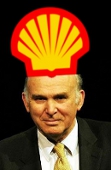
Moody-Stuart took over as chair of Shell in 1997, after the murder of Ken Saro-Wiwa in 1995, and began re-branding the company as environmentally and ethically responsible. The transformation, however, was no more than skin-deep. Shell has made a big noise about its commitment to renewable energy, but the amount it invests in green energy is pitiful in comparison to the money sloshing around in its ever expanding oil empire: the company is so far on track for the ambitious target of a 5% yearly increase in oil and gas production. Shell has not extracted itself from Nigeria, but only increased its oil extraction there; and it is now also one of the oil companies that Human Rights Watch has accused of being complicit in the killing and displacement, by the government of Sudan, of thousands of civilians living around the country’s oil fields.17

Other Moody-Stuart directorships include multinational bank HSBC and the mining giant Anglo American. HSBC is funding the expansion of industrial soybean production in Brazil through multinational Grupo Andre Maggi, the trans Thai-Malaysia oil pipeline, the East Siberia gas pipeline and the Rio Blanco copper mine in Peru.18 Anglo American was a pillar of apartheid in South Africa, with a history of using the repressive security services to control and exploit its workforce.19

Mark Moody-Stuart is most famous for wrecking UN environment summits and promoting 'voluntary action'.20 He headed up the 'Business Action for Sustainable Development' (BASD) initiative, launched in 2001 to prepare for the Earth Summit in Johannesburg. The BASD called for the voluntary regulation of corporations through a 'stakeholder' model. This involves 'partnership and dialogue' between government, NGOs and business, resulting in a few voluntary codes, no accountability and the co-option of the major voices of opposition.

BASD's efforts were extremely successful. The Earth Summit is widely accepted by environmentalists as having been an unmitigated disaster. Corporations managed to completely escape any regulation of their activities and the only thing of note that was achieved was a framework for voluntary partnerships between big business, governments and NGOs. In other words it will be 'business as usual' for the corporations - thanks to the efforts of BASD and its members. A perfect illustration of greenwash can be seen with the BASD's decision to fund 'grassroots sustainable development projects in the most needy communities in Africa' as a 'memorial' to the Earth Summit. They encouraged companies to invest in this project as a way of 'off-setting their C02 emissions'. The 'grassroots sustainable development projects' included several nuclear energy projects and an oil and gas pipeline.21

In July 2000 the G8 leaders met in Okinawa for the 26th Summit. They agreed to set up a Renewables Task Force with a remit to identify actions that can be taken to promote renewable energy in developing countries. While still chair of Shell, Mark Moody-Stuart was chosen to co-chair the Task Force with Italian environment minister Corrado Clini. See section on 'Climate Change' for more details.

Moody-Stuart and the Global Business Coalition on HIV/AIDS

Moody-Stuart is likely to put in an appearance at Gleneagles this summer as co-chair of the Global Business Coalition on HIV/AIDS.22 With HIV/AIDS so central to the G8's Africa Agenda, the Coalition, which argues that above all confronting the epidemic makes good business sense, are very likely to make their presence felt. The Coalition already works in partnership with UN/G8 initiative, the Global Health Fund,23 and had a lobbying presence at the G8 Summit in Genoa.24

The Coalition offers corporations a range of different responses to the crisis, from workplace awareness programmes to more active 'corporate citizenship'.25 The Coalition also includes pharmaceutical giants GlaxoSmithKline, Pfizer, Merck, Roche and Bayer. These companies were among the 39 drugs companies who, in 2001, accused the South African Government of violating patent rules over legislation that called for cheap generic versions of expensive branded AIDS drugs to be made available to the millions of HIV-positive South Africans. The court case was a massive public relations disaster for the pharmaceutical industry which was accused of putting profit before the lives of millions of people in the developing world. UK drinks multinational Diageo is also a member of the Coalition (See 'Diageo' section).

Some would argue that these corporations are actually benefiting from the economic climate, as promoted by the G8, which has exacerbated the AIDS epidemic in the region. Debt and rapid economic restructuring to catapult these countries into the global economy has resulted in rapid social change, endemic economic insecurity and the subordination of women.26


The Elephant in the Room: What the G8 won't be discussing

Politicians pose for a photo opportunity, while their aides release a pre-agreed text, packed with harmless platitudes. These summits have an unwritten rule; agreements mustn’t undermine any leader’s standing at home. This prevents serious negotiations but that is not the point. The point is to turn domestic politicians into global statesmen.
Liam Halligan27

It is very admirable that New Labour wants to focus on development and climate change as key issues for its presidency of the G8. It is also clear that, through these issues, Blair wants to establish himself as a true 'global statesman' as well as distancing himself from the antics of George Bush. However, if G8 members were really interested in their stated aim of global stability, perhaps they should look closer to home - across the negotiating table, in fact - and start calling the United States to account:

The 'war on terror'– Despite 'interim' elections, it seems unlikely that Iraq will be stable for a long time. Meanwhile the corporations of the 'victorious' coalition continue to carve up the country with lucrative 'reconstruction' contracts.28 Globally, the shock-waves of the attack on Iraq in the Arab world are having huge ramifications. The US has made it clear that Syria and Iran are now on its expanded hit-list, without feeling the need to justify its actions to the rest of the world any more. Meanwhile, Afghanistan slips back into warlordism and collapse, but now with a US-friendly corrupt and incapable regime.

Bush's refusal to deal with climate change – In November 2004, Russia finally agreed to ratify the Kyoto protocol. George Bush, however, has said that although the US has signed the agreement it will not ratify the outcome. He claims the cost of meeting Kyoto's commitments would be too high for the US economy. Meanwhile, for all its diplomatic and economic import, the treaty will likely have a minimal impact on the climate.

The US decision to embrace oil dependence and turn a blind eye to the imminence of peak oil (the point where oil demand outstrips oil production) could also have devastating effects on the global economy.29 But for all Blair's rhetoric about tackling climate change at the summit, these items seem to have slipped off the agenda. Some climate campaigners fear that the whole issue of climate change will be sidelined by the time we get to the actual summit, as it is clearly an issue on which no great progress and pronouncements can be made due to the intransigence of the US.

The potential collapse of the US dollar – This, more than any other, is the imminent threat hanging over the world's economies. At the moment the dollar is being propped up by what could be called 'the balance of financial terror'. The Japanese, Chinese and European economies are holding more and more dollar assets, because they are afraid that if they don't, the value of the dollar will crash through the floor, with knock-on effects around the world. The US economy has been plunged into crisis partly because some of the OPEC oil producing nations (such as Iran and Venezuela), are considering selling oil in Euro instead of dollars. The US economy is also endangered by the huge budget and trade deficits run up by the Bush administration, through tax cuts for the rich and high spending, especially on defence and security. Despite frantic attempts by European ministers to persuade the US to pay attention to the global effects of the weak dollar, the US Federal Reserve has not reacted.

The G8's failure to prioritise these issues suggests that far from the tough statesmen they like to be portrayed as, its leaders are no more than a gang of frightened bullies, backing each other up against the outside world but unable to deal with their own internal problems.

References
1.Binghampton University, Wallerstein, Immanuel, Cancun, the collapse of the Neo-Liberal offensive, Commentary No. 122, Oct. 1, 2003, http://fbc.binghamton.edu/122en.htm, last viewed 07.03.05
2.IMF / World Bank:50 Years is Enough, G8 (Fiction and) Fact Sheet, www.50years.org/factsheets/g8_fiction-fact.html, last viewed 07.03.05
3.University of Toronto G8 Research Group, John Kirton, The Road from Rambouillet to the Sea Island Summit. www.g7.utoronto.ca/scholar/kirton2004/kirton_atlanta_040507.html#conclusion; last viewed 07.03.05
4.G8 Renewable Energy Task Force, Final Report, July 2001 www.g7.utoronto.ca/energy/G8_report_2001.pdf, last viewed 07.03.05
5.Medicines Sans Frontieres, 'Open letter to members of the board of directors and technical review panel of the global fund to fight AIDS, tuberculosis and malaria', African Policy E-Journal, 22/04/02, www.africaaction.org/docs02/gf0204.htm, last viewed 07.03.05
6.Corporate Europe Observatory, 'ICC Fact Sheet #1 - The International Chamber of Commerce,' www.corporateeurope.org/icc/intro.pdf, last viewed 07.03.05
7.International Chamber of Commerce (ICC) website, 'Business Groups unite in pressuring the G8 to boost Doha trade round', 21.05.03, www.iccwbo.org/home/news_archives/2003/stories/brt.asp, last viewed 07.03.05
8.ICC website, 'Business and the Global Economy', ICC statement on behalf of world business to the Heads of State and Government attending the Evian Summit, 1-3 June 2003 www.icc-deutschland.de/icc/frame/se_20030609_1.html, last viewed 07.03.05
9.One World Trust (2003) Power Without Accountability: The Global Accountability Report 2003, One World Trust, London.
10.ICC website, 'ICC elects new chairman and vice-chairman', 03.12.04 www.iccwbo.org/home/news_archives/2004/chairmanship_2005.asp, last viewed 07.03.05
11.'Action Alert', Asian Labour Update, www.amrc.org.hk/4509.htm, last viewed 07.03.05
12.Doosan Heavy Industries and Construction website, Frequently Asked Questions www.doosanheavy.com/eng/4/sub4_06.htm, last viewed 07.03.05
13.ICC website, 'Business and the Global Economy', ICC statement on behalf of world business to the Heads of State and government attending the Sea Island Summit, 8-18 June 2004. www.iccwbo.org/home/statements_rules/statements/2004/G8_statement.asp, last viewed 30.3.05
14.ICC website, 'Business calls on the G8 leaders to set aside disagreements over Iraq and work together' www.iccwbo.org/home/news_archives/2003/stories/g8.asp, last viewed 30.3.05
15.University of Toronto G8 Information Centre, 'Prime Minister Tony Blair's Statement to the House of Commons on the G8 Sea Island Summit', London, 14.06.04, www.g8.utoronto.ca/summit/2004seaisland/blair040614.html, last viewed 07.03.05
16.www.thecorporation.com/
17.Energy Administration Information website, Country Analysis Briefs, Nigeria, August 2004, www.eia.doe.gov/emeu/cabs/nigeria.html, last viewed 07.03.05; Human Rights Watch (2003), Sudan, Oil, and Human Rights, www.hrw.org/reports/2003/sudan1103/, pt.4, last viewed 07.03.05
18.'Principles, Profits or just PR?' Bank Track anniversary report June 2004, www.banktrack.org/fileadmin/ user_upload/documents/0_BT_own_publications/PPP_report_0406_final.pdf, last viewed 07.03.05
19.Multinational Monitor, Volume 9, Corporate Profiles, John Summa, 'Anglo-American: a Pillar of Apartheid', Sept 1988, www.multinationalmonitor.org/hyper/issues/1988/09/mm0988_08.html, last viewed 07.03.05
20.Kenny Bruno and Joshua Karliner, Earthsummit.Biz: The Corporate Takeover of Sustainable Development (Food First, 2003)
21.'UN-sustainability' Corporate Watch Newsletter, Issue 9, June-July 2002, www.corporatewatch.org.uk/newsletter/issue9/un_sustainability.htm, last viewed 07.03.05
22.Moody-Stuart's co-chairs include Juergen E. Schrempp, chairman of DaimlerChrysler.
23.Global Business Coalition on HIV / AIDS, 'Nine Big Firms Pledge to Help Fights AIDS', www.businessfightsaids.org/site/apps/nl/content2.asp?c=nmK0LaP6E&b=239237&ct=280213
24.Ibid.
25.Global Business Coalition on HIV / AidS homepage, 'Welcome to GBC', www.businessfightsaids.org, last viewed 07.03.05
26.Labonte, R; Schrecker, T and McCoy, D 'Health and HIV/AIDS: fine words and fatal indifference' in Arguments against the G8. Hubbard, J and Miller, D eds. Pluto Press, London 2005
27.Channel 4 News, 20 July 2001 (Genoa)
28.Corpwatch, War Profiteers, last viewed 07.03.05
29.Association for the Study of Peak Oil and Gas website, www.peakoil.net, last viewed 07.03.05; The Community Solution website, www.communitysolution.org, last viewed 07.03.05
 
powered by the webbler | tincan